

Some of you have heard my story that one of my first serious contacts with Buddhism came through a book by the thirteenth century Zen master Eihei Dogen, the founder of the Japanese Soto Zen Sect. It was a book I picked up in the gift shop of the Tokyo Hilton before I went to Kyoto to visit the Zen gardens there. I had become enchanted with these gardens while studying Landscape Architecture in the early sixties. While I was in Tokyo on business, I made a side trip to finally see them. My life was forever changed.
That book, the Tenzo Kyokun (Instructions for the Zen Cook) was what started me on the path of the Buddha. I learned that the “tenzo” who managed the meals for the monks at a monastery was one of the most important officers in that temple complex. As written in the Chanyuan Qinggui, the tenzo should put his “awakened mind to work, making a constant effort to serve meals full of variety that are appropriate to the need and the occasion, and that will enable everyone to practice with their bodies and minds with the least hindrance.” The meals should be prepared with the attention used in preparing a meal for the emperor. The menu for the meals should be posted in front of the abbot’s room as well as in front of the study hall. And each meal should contain the six flavors (bitter, sour, sweet, salty, mild, and hot) and the the three virtues (1-light and flexible, 2-clean and neat, and 3-conscientious and thorough). When I had the opportunity to stay and practice at Japanese Monasteries both in Japan and America, I found these principles still in play. I learned and loved the many bowl Oryoki method of serving and eating and preparing food for those on retreat.
When I decided to offer the Solitary Retreat at the temple, I revisited this book and am considering what I can apply to our situation at the temple.We did develop a way of using the Oryoki service for formal retreats, but revised it when faced with the restraints of being COVID compliant. We did adopt the two meal format with fruit and other snacks available for those who cannot adapt to intermittent fasting. However, the solitary aspect of these retreats meant that Oryoki practice would not work, but I kept the chants used in the retreat manual for individual use, if wanted. When my assistant, Froggie, went back to China and I had a retreat to take care of, I had no choice but to be the temple tenzo and want to continue to do so. Planning, purchasing, cooking, and serving two meals a day was not something I had done since I was Dorje PaMu’s cook decades ago. I have reread the Tenzo Kyokun several times and am working to reorganize the temple kitchen to better function as a temple kitchen that can deliver the “meals full of variety that are appropriate to the need and the occasion and that will enable everyone to practice with their bodies and minds with the least hindrance.” I find it to be a very great challenge and opportunity for practice. I am very grateful.
Now that we are doing formal group meditations again, it is again appropriate to repeat these concepts as they apply to the Tathagata True Dharma Zen Silent Retreat format. The Buddha Hall becomes our Dining Hall. We ceremonially unfold our wrapped Buddha Bowls and begin the chants that set the context, state our aspirations, and make offerings to express our gratitude and request blessings. The tenzo has also made offerings and lit incense at the kitchen altar and delivers the food to the servers. We then take turns serving each other and when everyone is served we chant:
THE FIVE INSIGHTS
1-Innumerable labors brought us this food. We should know how it comes to us.
2-Receiving this offering, let us consider whether our virtue and practice deserve it
3-We must prohibit greed and keep our precepts
4-We regard this meal as medicine to sustain our life.
5-For the sake of enlightenment, we now receive this food.
We may take seconds, receive hot water from the servers, wash our bowl and retie our bowls. There are three bowls used for breakfast and the evening meals and four for the major meal at lunch. At lunch we also make food and chant offerings for the local spirits and deities. There is no chanting at the evening “snack” as it cannot be called a meal.
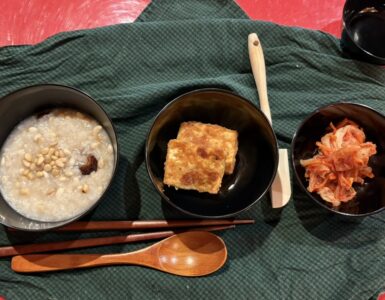
We will serve food three times with snacks mid morning and mid afternoon. Breakfast Oryoki is usually a congee with eggs or tofu and related condiments. Lunch has four bowls with a grain or salad in the Buddha Bowl, and soup, other vegetables, and eggs or tofu or other vegetarian protein in the other bowls. The evening meal is optional, but if served it will usually be a light soup, bread or crackers, and fruit. Each meal has an ethnic theme ranging from African to Chinese, Mediterranean (Greek, Italian), Middle Eastern (Lebonese, Persian), Indian, Japanese, Korean, Native American, Thai, Vietnamese, and others.
Note: Originally posted November 29, 2023.

Add comment