
I read the Dharma King’s “Essay on Experiencing Beneficial Effects (Sometimes also called just “Experiencing Effects”) at the December 13 class and explained that since this is such an important sutra, it would be included as separate LFBS course C01 along with its companion “Essay on Relationship between Master and Disciple that Must Be Read.” C01will be a prerequisite for courses related to esoteric practice.
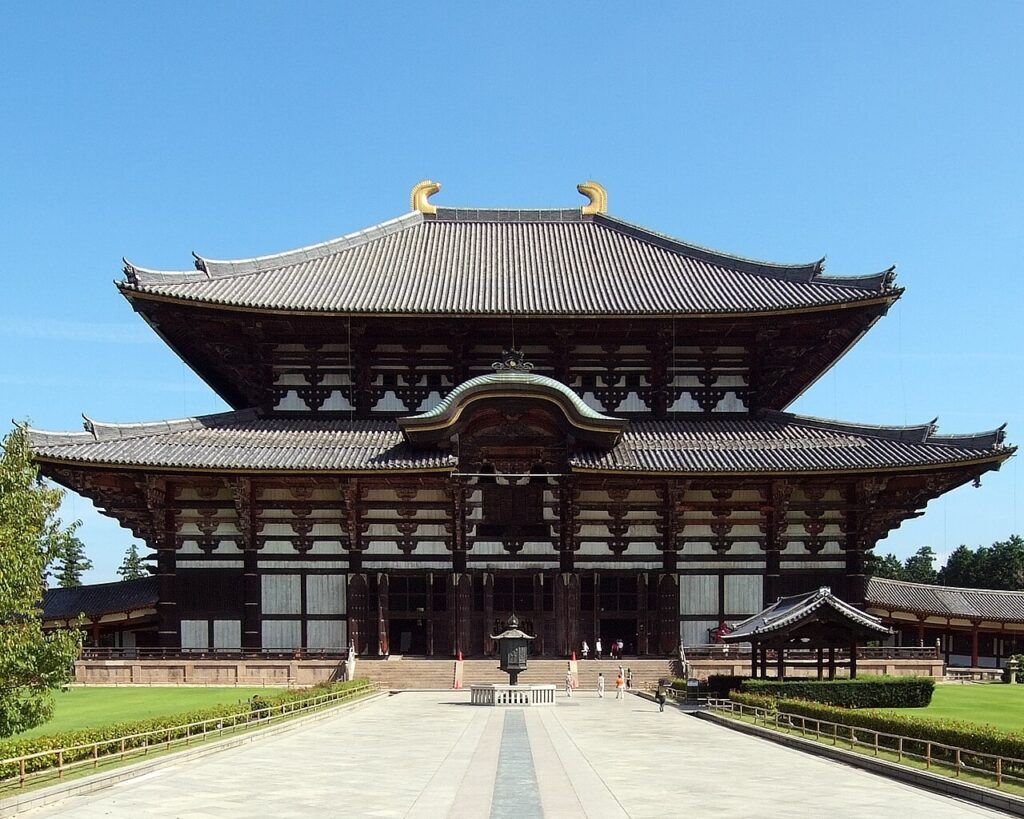
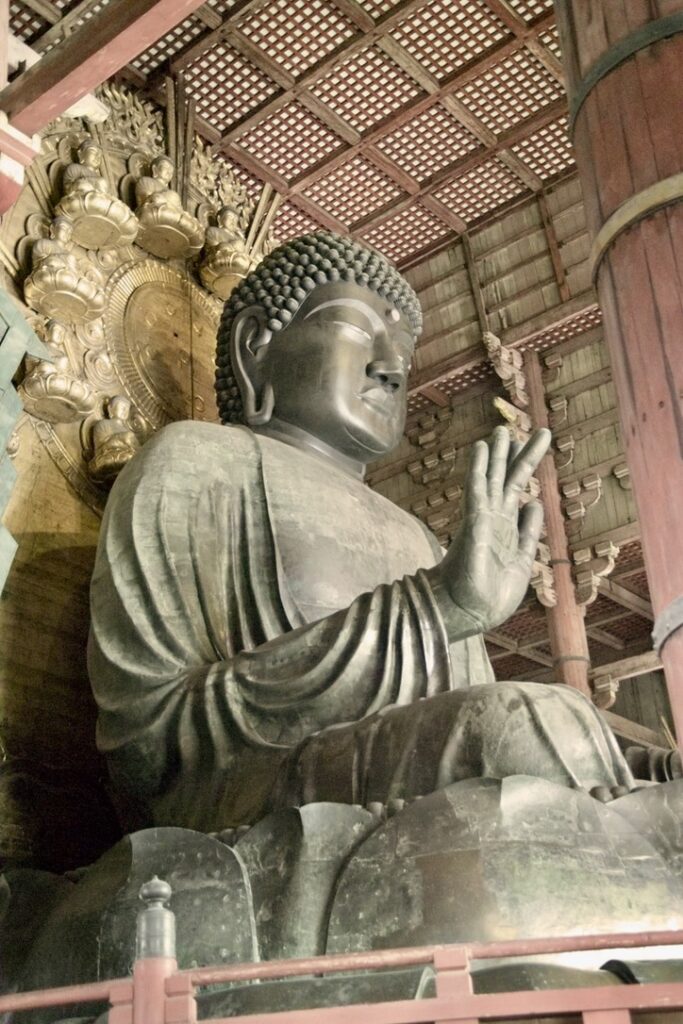
Photo above is of the Great Buddha Hall at Todai-ji that houses the world largest bronze Buddha, the Vairocana Buddha. Dharma King Zun Cheng, the master of H.H. Dorje Chang Buddha III and Dorje PaMu, was a manifestation of the Vairocana Buddha.
The following are some of the questions and responses related to this essay:
What is meant by the term “Experiencing Effects”?
“It is also called what one experiences or receiving consequences. Thus, actions involving good deeds, bad deeds, good fortune, and pain can never be separated from their inherent karmic effects. Therefore, the ultimate broad meaning of ‘experiencing effects’ is “following causes, effects [or their fruits] appear.” This includes worldly ways and supra-mundane ways.”
What are the two ways we experience Dharma benefits as effects?
“Those who cultivate themselves and learn the truth of the mundane worldly rules experience Dharma benefits as effects through cultivating and refining the two Dharmas (gong功 and xing行): learning the way is ‘gong’ and practicing it or your conduct is ‘xing’.”
What is meant by the three karmas?
“The three karmas are body, speech, and mind. The body means everything related to what the body does, including all actions. Speech is all sounds of spoken words and changes in breath, including subtle or non-verbal, nonlinguistic signs. Mind is the consciousness that can differentiate between large and small—all kinds of consciousness or thoughts—big thoughts, small thoughts. That is, giving rise to both large and small thoughts. Mind governs the two karmas of body and speech. That is, body and speech will be applied only after a decision has been made through mind.”
Why is cutting off doubt and establishing resolute faith so important in Dharma Practice?
“Thus, I am now telling practitioners, before they enter the dharma practice they must first sincerely understand the rule of the correspondence of the three karmas. They will then enter the state of cutting off doubt and establishing resolute faith, which establishes the cause for a very high effect.”
And why is “cutting off doubt” so important?
“It is because the prerequisite for experiencing beneficial Dharma effects is reliance upon the Master. Only through relying upon the Master, cutting off doubt, giving rise to faith, and cultivating oneself in accordance with the Dharma can one experience effects. One can see that a doubtful heart is an evil demon that destroys the path to enlightenment.”
Then, what is meant by “doubt”?
“First, one doubts the Master, thinking he or she is not qualified to be a Master. Second, one doubts the Buddha-dharma, thinking that it is not real. Third, one doubts oneself, thinking that one is a sinner. Thus, before one enters the mandala, one must eliminate these three types of doubt and maintain a firm and constant sincere heart. Only when one makes one’s causal stage pure can one experience unlimited effects.”
There are other principles in this essay, especially how they relate to esoteric practice including the meaning of “yoga,” “correspondence,” and “having doubts”. The reasons for people not benefiting from their practice are also explained along with how worldly ways differ from the way of the Buddha. Even the nature of demons and their powers are discussed. So is the metaphor of the Dharma light of the Buddhas and Bodhisattvas being like the sun and the powers and importance of the holy Dharma Protecting Deities. This is a very important essay that any Buddhist should understand and follow, especially those on the esoteric path and anyone seeking tantric initiation.
CLICK for Learning from Buddha Seminary (LFBS) course C01-Essays from Dharma King Zun Sheng.
CLICK for December 13, 2015 article on reading of essay.


Add comment