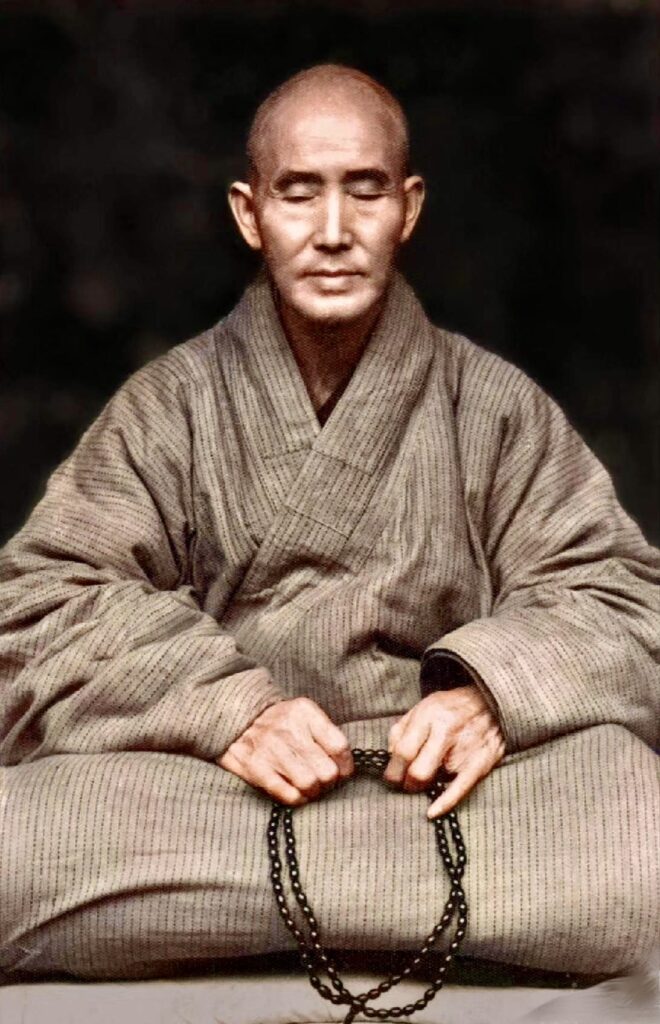
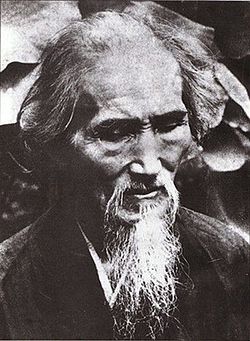
This holy man was a great leader of Chinese Buddhism over a very long and difficult time in China. It appears that he holds a position within Chinese Buddhism that is similar to that of Milarepa in Tibet. He revitalized all five major Chan (Zen ) schools (Wei Yang or Guiyang, Lin Ji, Cao Dong, Yu Men, and Fa Ya). He was born in 1840 during the Quing dynasty (1644-1911) and lived until 1959. His name Xu (Hsu) Yun meant “Empty Cloud” and is the name of his autobiography, which along with his teachings, were translated by Charles Luk into English. They are available on Amazon and through other internet sources.
CLICK for PDF of “Empty Cloud: The Teachings of Xu (Hsu) Yun.”
H.H. Dorje Chang Buddha III frequently mentioned Dharma Master Wu Yun as an example of one who had realized the truth of prajna.
The first 27 minutes are an introduction with the autobiography starting after that.
The following story from Wikipedia tells about his experience at Gaomin Monastery:
“When Xuyun was fifty-six, the Abbot Yue Lang of Gaomin Temple in Yangzhou was going to convene a twelve-week session of continuous dhyana meditation. Preparing to leave, the group asked Xuyun to go first. After reaching Di Gang, he had to cross the water, but the ferry left without him as he had no money. As he walked along the river’s edge, he suddenly lost his footing and fell into the rushing water, where he bobbed helplessly for a day and night before being caught in a fisherman’s net. He was carried to a nearby temple, where he was revived and treated for his injuries. Feeling ill, he nevertheless returned to Yangzhou. When asked by Yue Lang whether he would participate in the upcoming weeks of meditation, he politely declined, without revealing his illness. The temple had rules that those who were invited had to attend or else face punishment. In the end, Yue Lang had Xuyun beaten with a keisaku. He willingly accepted this punishment, although it worsened his condition.”
“For the next several days, Xuyun sat in continuous meditation. In his autobiography, he wrote: ‘[in] the purity of my singleness of mind, I forgot all about my body. Twenty days later, my illness vanished completely. From that moment, with all my thoughts entirely wiped out, my practice took effect throughout the day and night. My steps were as swift as if I was flying in the air. One evening, after meditation, I opened my eyes and suddenly saw I was in brightness similar to broad daylight in which I could see everything inside and outside the monastery…’ But he knew that this occurrence was only a mental state, and that it was not at all rare. He did not become attached to this achievement, but continued his single-minded investigation of the question, ‘who is mindful of the Buddha?’ He delved into this topic without interruption.”
“Xuyun composed a commemorative verse for the oft-cited moment of profound insight, which was galvanized by the sound of a breaking teacup in the Chan Hall:
A cup fell to the ground
With a sound clearly hears
As space was pulverixed,
The mad mind came to a stop.”
CLICK for article on Elder Dharma King Dorje Losang who had apprenticed under Master Xu Yun.
CLICK for article on Elder Monk, Yi Zhao, a disciple of H.H. Dorje Chang Buddha III who became the Dharma holder of the Lin Ji Chan lineage after Xu Yun.
CLICK for interview with Elder Monk Yi Zhao after June 2000 Buddhas Bestowing Nectar Dharma Assembly in Southern California.
First posted October 13, 2025.
Add comment