
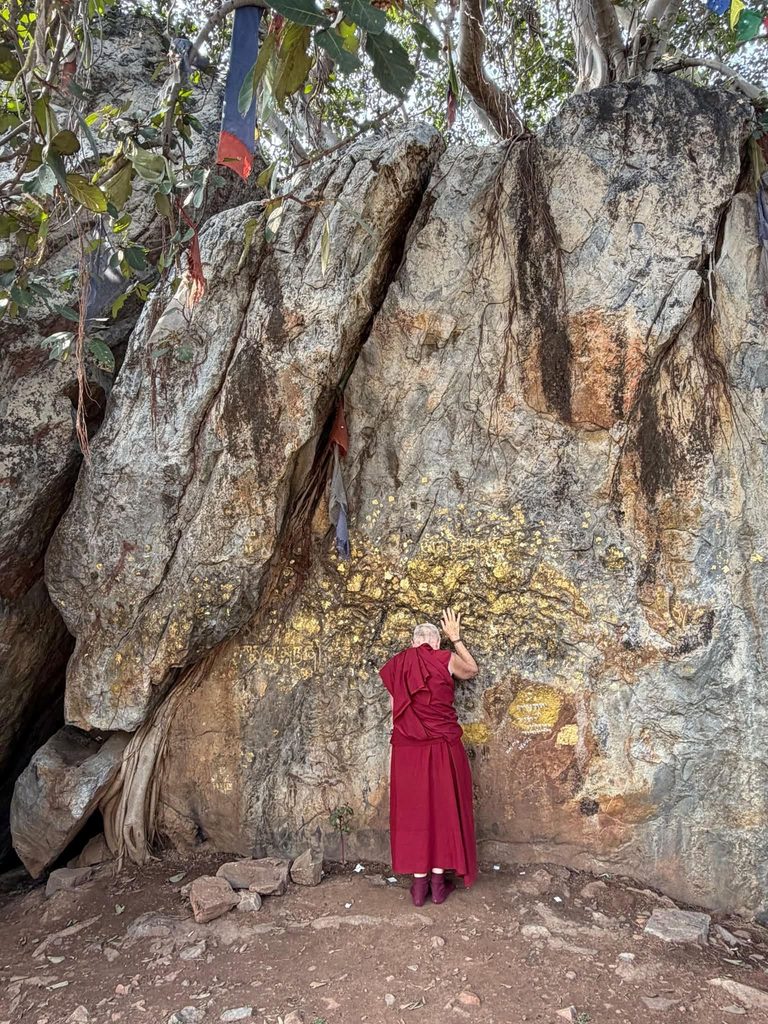
Vulture or Eagle Peak (Grdhrakuta), a rocky hill near the ancient city of Rajagrha (modern Rajgir, Bihar, India) is one of the most sacred places in buddhism. It was the capital of the kingdom of Magadha during th Buddha’s lifetime and the location of many important teachings. I always wondered the source of this name and with this photo, I understand. Its peak does resemble a vulture sitting with folded wings. wikipedia also offers that there were many bultures lived here among the peak’s rocky cliffs.
Some of the most famous Mahayana Sutras were given here including the Lotus Sutra and the numerous Prajnaparamita Sutras. In Chapter 16 of the Lotus Sutra, the Buddha declares that although beings think he has passed into nirvāṇa, he continually remains teaching on Holy [Vulture] Eagle Peak. Thus Vulture Peak becomes not merely a historical location but also a symbol of the Buddha’s eternal presence.
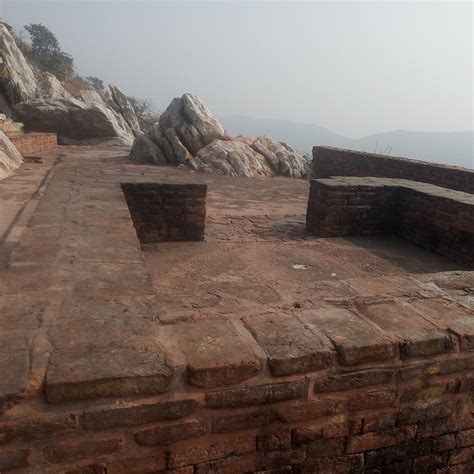
During the Buddha’s life the site was not a large monastery, but a rugged hill with rocky ledges, small caves, meditation spots, and gathering place for the monastics and lay followers.However, Chinese pilgrims such as Faxian (5th century)and Xuanzang (7th century) later describd the caves, preaching platforms, stupas, and the sites associated with the Buddha’s preaching. Although those ancient structures largely do not survive intact today, the well documented accounts of those ancient pilgrims helped identify the sacred locations that pilgrims now visit.
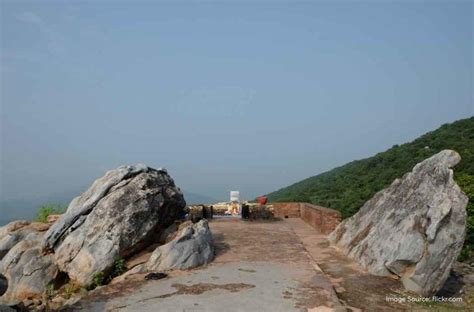
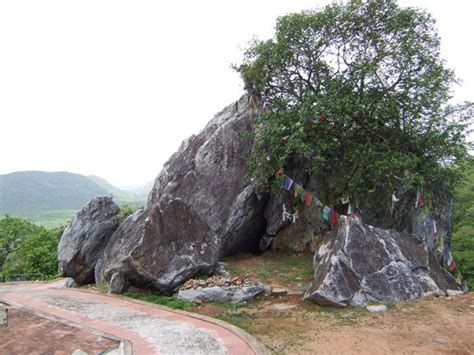
This is not a towering mountain, but a fairly small hill. When you reach the top, you can stand on a rocky ridge overlooking the modern city of Rajgir and be at a location repeatedly mentioned in the early Buddhist scriptures and revered across the Theravāda, Chinese, Japanese, Korean, and Tibetan traditions.

The site cannot be explored by auto or road. You would need to ascend on foot with the trail, a stone-paved pathway and stairway that leads upward, starting at the base of the hill and climbing to the top through rocky and uneven terrain. The climb is not extremely difficult, but it is steep in places. Many pilgrims stop periodically to chant, meditate, or simply enjoy the scenery. The natural landscape remains remarkably simple and rugged, rather than heavily built over. It is near the Venuvana (the Bamboo Grove monastery area) in the broader Rajgir region and the nearby Vishwa Shanti Stupa (World Peace Pagoda). The geopraphy is so important to all the branches of Buddhism because it preserves the entire an entire teaching landscape that is a major part of the Pali Canon, the Chinese Agamas (Sanskrit), the most famous Mahayana Sutras, and the Tibetan Kanjur. They all contain teachings that were set in or around this sacred valley.
CLICK for November 14, 2026 article on the “Five Time Periods of Shakyamuni Buddha’s Teaching.”
CLICK for November 14, 2026 article on “What Is the Tripitaka?






Add comment