
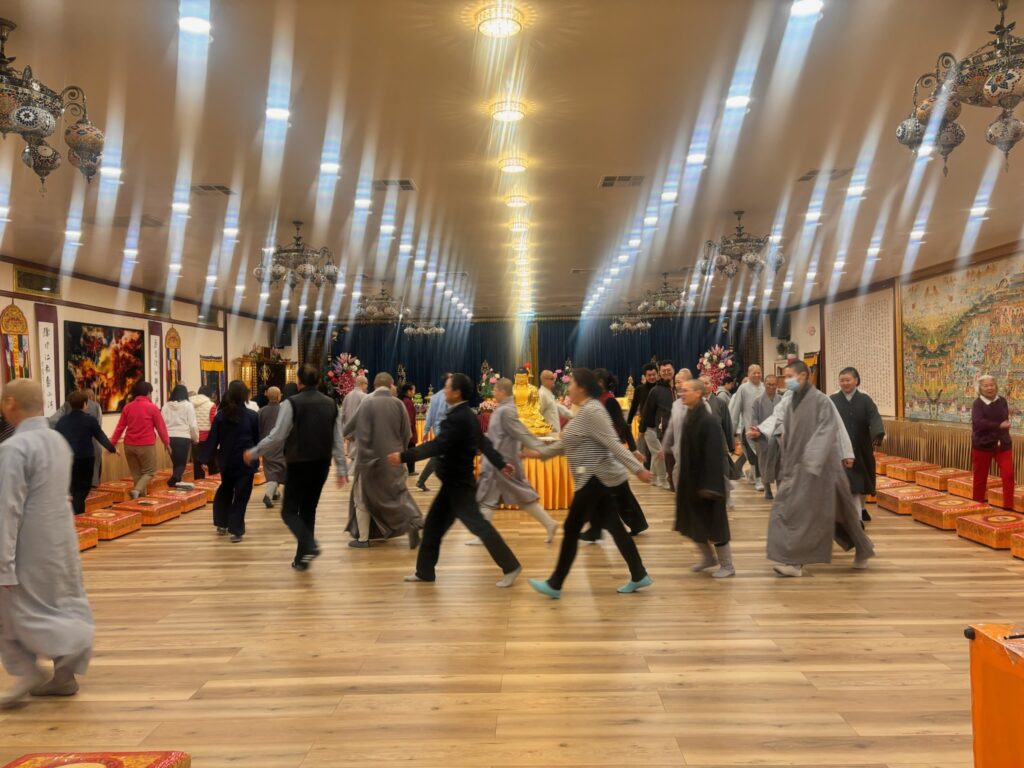
Last June the Abbots from the Benevolence and Pure Cultivation Temples in Las Vegas, Venerable Zhengda Jiaozun and Venerable Fa Chao, led a demonstration of their unique form of moving or running Zen practice with the help of monastic and lay disciples from their temples. This was part of the annual program held each summer or late spring at the Holy Heavenly Lake in Buddhisttown in Hesperia, California.
Those temples have agreed to sponsor a two-day Meditation Retreat (workshop) on November 13 and 14 at the Benevolence Temple located at 700 East St. Louis Avenue, Las Vegas with English translation for those of us who would like to learn and practice this method but who do not understand Chinese. The following is a very short video of our experience of this form of moving meditation that we saw in June at Holy Heavenly Lake.
To attend the November 13 & 14, 2025, “Moving Meditation” event at the Benevolence Temple, please CLICK and complete the form. There are a limited number of slots for this event and they will be honored on a first come, first served basis. Registration will close once this number is reached. The form also includes more information about the event.

The first day, November 13, 2025, starting at 8:30 am, is for registration and preparations and with an orientation session on the rules and procedures from 2:30 until 5:00 pm. The formal meditation practice takes place on the second day, November 14, from 9:00 am until 5:30 pm. There will be a total of ten meditation sessions–5 sitting meditation sessions and 5 walking or moving meditation sessions that day. Meals will be provided by the temple for all attendees throughout both days. There are no fees for participating in this event, but you must register to attend as noted above. You should read H.H. Dorje Chang Buddha’s The Great Dharma of Zen Meditation in preparation for this mini retreat.
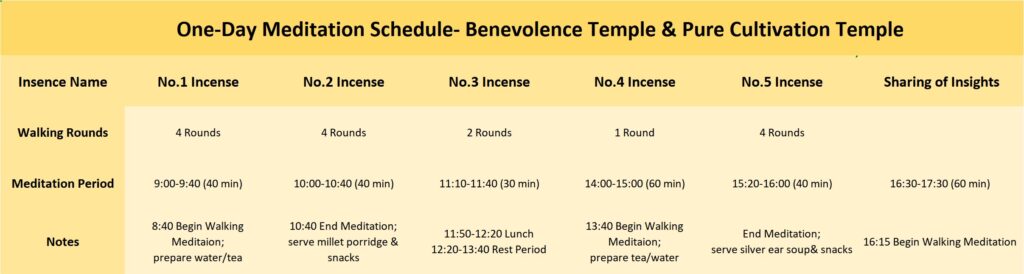
This is how this method works: In ancient times before clocks were invented, burning incense served as a method of tracking time. Thus, each “incense” here represents a unit of time rather than just a fragrance. The true timekeeper in the meditation hall is the Weinuo (hall discipline master), who adjusts the pace according to the practitioners’ condition.
The varying session lengths you see—some 40 minutes, others 60—are carefully designed to balance movement and seated meditation. This rhythmic alternation helps beginners adapt more easily to the hall’s discipline. The walking meditation before each sitting session serves to activate one’s energy and blood circulation through movement, preparing the body and mind for stillness.
Moreover, the walking meditation may stop abruptly at any moment. If one continues walking after the signal, it indicates distracted attention, and that person may receive a reminder with the incense board (cudgel or xiāng bǎn in Chinese; keisaku or kyōsaku in Japanese). This practice helps make mental wandering immediately apparent, allowing practitioners to notice scattered thoughts in real time.
The following article provides more background on this meditation method and links to even more.
During the late afternoon of June 3. 2025, Ven. Zhengda Jiaozun started in a field next to Heavenly Lake with a summary of her Buddha Master’s (H.H. Dorje Chang Buddha III’s) The Great Dharma of Zen Meditation while Ven. Fa Chao, with help from his assistant monks, explained how Walking or Moving Meditation was practiced. I am guessing there were a couple hundred participants with an extra row of chairs around the mandala for spectators. Even with—or maybe because of—the intermittent threat of rain, it was impressive. However, everything was in Chinese, and there was no attempt to officially translate anything for the handful of English speakers present. We did not attempt to film the actual meditation practice or even the specific instruction, but a Benevolence Temple nun, Fa Zhi, provided the above picture of how they do this at their temple without the ominous threat and actual rain that we had in Hesperia. She also translated for Ven. Fa Chao who explained a lot more about this practice in a follow up ZOOM call.
I had seen and heard enough to want to know more and see if there was any way we could get an English demonstration of this practice. My first thought was to have the monks and nuns from Las Vegas join our meditation retreat at the Unitarian Camp de Benneville Pines we had planned for September. Zhengda was most cooperative and assigned the talented translator, Fa Zhi to work with me on arrangements. With some help from my friend James Debates, who had moved to Las Vegas and was very good at making things happen, I had a very informative ZOOM meeting with Ven. Fa Chao, made possible by Fa Zhi’s translation. They were willing to come to the retreat, but we were only able to get 4 days and only had the use of one very nice cabin and a small meeting room—neither suitable for this practice. If we had been there for the full seven days and had use of their very lovely large lodge for the practice like I wanted, we could have learned this “moving” form of zen practice, but probably would also have experienced the monsoon flooding that washed out the road to the camp from the south and flooded the camp.
Instead, I offered to come to Las Vegas to experience the moving meditation with English translation of the protocols, which will happen at the Benevolence Temple on November 13 and 14.
Ven. Fa Chao also explained that according to elder monks, the general methods of practice across the five Chinese Chan (Zen) schools are largely the same, differing mainly in specific details. These five schools are known as the the Wei Yang, Lin Ji (Japanese Rinzai), Cao Dong (Japanese Soto), Yu Men, and Fa Yan Schools. Today, among existing Chan monasteries, the Zhen Ru Chan Temple is considered to have preserved the most complete regulations of the Chan Hall and specific methods of practice. At present, the Wei Yang School’s traditional bell-and-board (used to mark time and guide monastic routine) still hangs in the Chan Hall at Mount Yunju. Ven. Fa Chao also said that the Chan hall regulations they follow in Las Vegas are inherited from the Zhen Ru Chan Temple on Yunju Mountain in Jiangxi Province, China. Ven. Fa Chao trained and practiced in China at this temple.
I believe that the running-walking zen method used at the Gaomin monastery described by our Buddha Master in His Great Dharma of Zen Practice is an example of the same method they are using, only in a much less extreme form and is suitable for lay practitioners as well as monastics.
As I understand, they have a daily meditation starting around 2 or 3 in the afternoon in both of their temples, primarily for their monastics. However, sometimes serious lay practitioners also participate. They start with moving meditation, walking or running in circles with those who are able running faster in the center and others running slower in the outer circles, each to their own ability. The leader of the session determines the qualifications of who participates. Sometimes the focus may be on physical skill allowing only the most adept, sometimes more on inclusion to allow many. This enables people of different ages and mobility to participate. At least in ancient times in the Gaomin Monastery, only the athletically adept could participate. Likewise, sometimes it may be only male monks, sometimes both male and female, and sometimes both lay and monastic. However, if possible, males would be on one side and females on the other like was done at Holy Heavenly Lakes. After the moving practice is finished, everyone goes to their seats or cushions, silently chants the two or three mantras from The Great Dharma of Zen Practice or the Heart Sutra and begin to practice their silent sitting meditation. There may be tea and snacks provided as well.
We do need to know how many will attend to make appropriate arrangements. These sessions will be open to any serious Buddhist practitioner. We just need to know your name and any limitations you may have. Please complete the form above ASAP. The temple only has space for 80 participants. I hope to see you there and, if we are able to learn this method, to sponsor another full seven-day retreat somewhere next year where we can practice it. Please also let me know if you are interested in that as well.
Gaomin Monastery Example from H.H. Dorje Chang Buddha III’s The Great Dharma of Zen Practice:
“We engage in zen for the purpose of realizing original nature, emptiness, or dharmakaya. This dharmakaya was not born and does not die. I will give an example to all of you. Some methods of zen practice are truly inexplicable but unfathomably profound. Take, for example, the Gaomin Monastery in Yangzhou. In ancient times, a great number of people there became accomplished through the practice of zen. At the Gaomin Monastery in Yangzhou, basically every seven days one person would awaken to zen, becoming enlightened and accomplished. That being the case, how did they do their zen practice? The dharma methods that they applied were not called by any of the names of those forms of zen that I just mentioned. Those dharma methods also did not include any of the zen practice techniques of those forms of zen that I just mentioned. That is why I say that there are a great many zen dharmas.“
“First of all, in ancient times when someone entered the Gaomin Monastery to practice zen, that person would first have to sign an agreement. That agreement was very simple. To put it bluntly, they agreed that they could be beaten to death with impunity. The one who beat them to death would not have to lose his own life. Additionally, they agreed to voluntarily carry out the dharma rules of the monastery. After they entered the monastery, there were many ways for them to practice zen. Here I will talk about three of those ways. They had to give up all of the dharmas that they previously learned. As soon as one arrived at Gaomin Monastery and entered the zen hall, one could not apply any previously learned dharmas.“
“Five people carried cudgels (香板 xiāng bǎn in Chinese; keisaku or kyōsaku in Japanese). Those five were called “the five great cudgel carriers.” Their specific task was to beat people. The practitioners had periods of running zen, each of which lasted the time it took for a stick of incense to burn from top to bottom. The stick of incense was not long. It was only this long. The practitioners had to jog. In the zen hall, many practitioners formed a circle and jogged. As they jogged, one of the cudgel carriers would strike his cudgel against something, which made a loud noise. As soon as he struck his cudgel against something, that loud noise sounded. When the jogging practitioners heard the striking sound from the cudgel, they had to immediately stop jogging. They were not allowed to jog even one more step. When the striking sound of the cudgel sounded again, they had to immediately resume their jogging. Have any of you seen a cudgel used by a cudgel carrier in a zen hall?“
(Everyone answers: No.)
“Sometime in the future I will find a time to show you a cudgel from the Gaomin Monastery in Yangzhou that was used in the past. As soon as the striking sound from his cudgel sounded, if you were still jogging, you would be taken aside and beaten to death. If you were not beaten to death, you were at the very least maimed. Thus, the minds of those practitioners were of course extremely focused. They were always focused on the sound of the cudgel. They were always fearful that they would be taken aside and severely beaten for continuing to jog after the striking of the cudgel sounded, or, if they had stopped jogging, for not immediately resuming their jogging after the striking of the cudgel sounded. Do you understand?“
“There was a sitting period, which lasted as long as it took for a stick of incense to burn from top to bottom. As soon as they sat down, the cudgel carriers in back of them would keep an eye on them. While sitting, the practitioners were not allowed to move in any way. The practitioners were absolutely forbidden to move. They were not permitted to recite the name of any Buddha or chant any mantra. If one was seen moving a bit, he was taken aside and severely beaten, to the extent of possible death. Therefore, after they sat down in a settled posture, as soon as the striking sound of the cudgel carrier’s cudgel could be heard, they did not dare move. They had to remain stiff for as long as the incense stick burned. They did not dare move in the slightest. The focus of their minds increased a hundredfold because they feared that they would inadvertently move, be taken aside, and be beaten, resulting in injury, deformity, or death.“
“Another example is the drinking of water. The practitioners had to go to the east side to draw water and then carry the water with both hands to the west side. Only then could they drink the water. Additionally, the cup of water had to be completely filled. If any water spilled to the ground as they were carrying the cup with both hands, they were taken aside and severely beaten.“
“Thus, the consciousness of those who practiced zen there did not wander. They did not think of other things. They did not rest. When they ate, they were not even allowed to make the sound of chopsticks hitting the bowl. As a result, their consciousness was forced to naturally not dare think of other things. Do you understand? Therefore, it is only natural that after our consciousness is united, we will not think things over and will not be distracted. Everyone fears being beaten to death. Do you understand? When you fear being beaten to death and death is used to force you, then you have no other choice. You must seriously deal with the matter. That is why in such circumstances it is very easy to cut off mistaken thinking. Through force, your thoughts are cut off. When your thoughts are cut off through force, your original nature emerges. As soon as your original nature emerges, you have broken through in your zen practice.“
“Therefore, by and large, at each seven-day retreat someone broke through in his zen practice at that monastery. Basically, there would be one breakthrough every seven days. How did they know someone broke through? The day someone broke through, he was ordered to write a verse for others to hear, enabling the abbot of the zen hall and the zen master to recognize him. That practitioner was later tested again to see whether he truly awakened to the truth through the practice of zen, whether he understood his mind and saw his nature. Do you understand?“
(Everyone answers: I understand.)
Links to More Information:
CLICK for January 23, 2026 video of Ru Lai Zheng Fa Meditation Retreat at the Benevolence Temple in Las Vegas, November 13-14, 2025
CLICK for November 26, 2025, article on Zhen Ru Chan Temple, Jiangxi, China, that includes a video of monks practicing this type of moving meditation.
CLICK for October 13, 2025, article on Venerable Xu Yun (1839-1959), an accomplished Qing Dynasty (1644-1912) Zen Master and Patriarch of five Chinese Zen schools—Wei Yang, Lin Ji, Cao Dong, Yu Men, and Fa Yan. Xu Yun shares his own experiences at the Gaomin Monastery.
CLICK for September 23, 2025, article on “Road to UU Camp washed out after retreat”.
CLICK for August 27, 2025, article on the Gaomin Monastery in Yangzhou, China reflecting H.H. Dorje Chang Buddha III’s teachings from The Great Dharma of Zen Practice.
CLICK for August 12, 2025, introduction to and the entire text of the discourse given on the Great Dharma of Zen Practice.
CLICK for February 5, 2025, article on other teachings by H.H. Dorje Chang Buddha III on meditation.
CLICK for January 21, 2024, article on the opening of the beautiful Benevolence Temple, Las Vegas, NV.


Add comment