
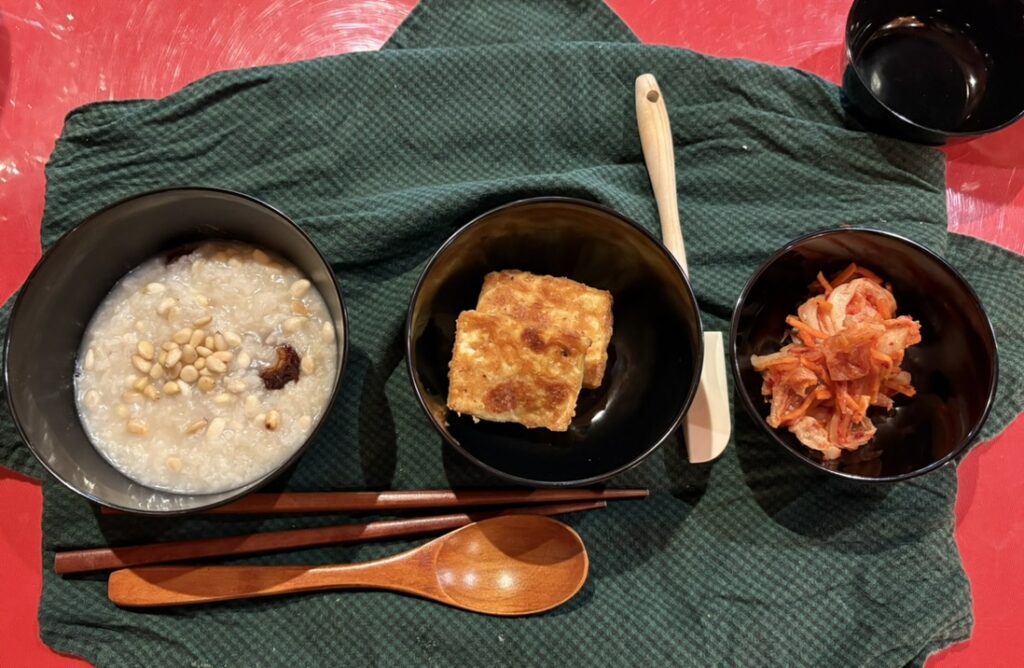
This Korean theme breakfast includes a Pine Nut Porridge or Congee with Jujube Dates, Baked Tofu and home made Kim Chi. Most breakfasts include a form of congee that is started the night before, an egg or tofu dish, and a related pickle or condiments. Since it is impossible to find commercial Kim Chi without garlic or onions, it had to be made before the retreat started. This meal is lacking anything green so we should add shredded lettuce for the tofu.
Pine Nut Porridge or Congee (Korean Jatjuk)
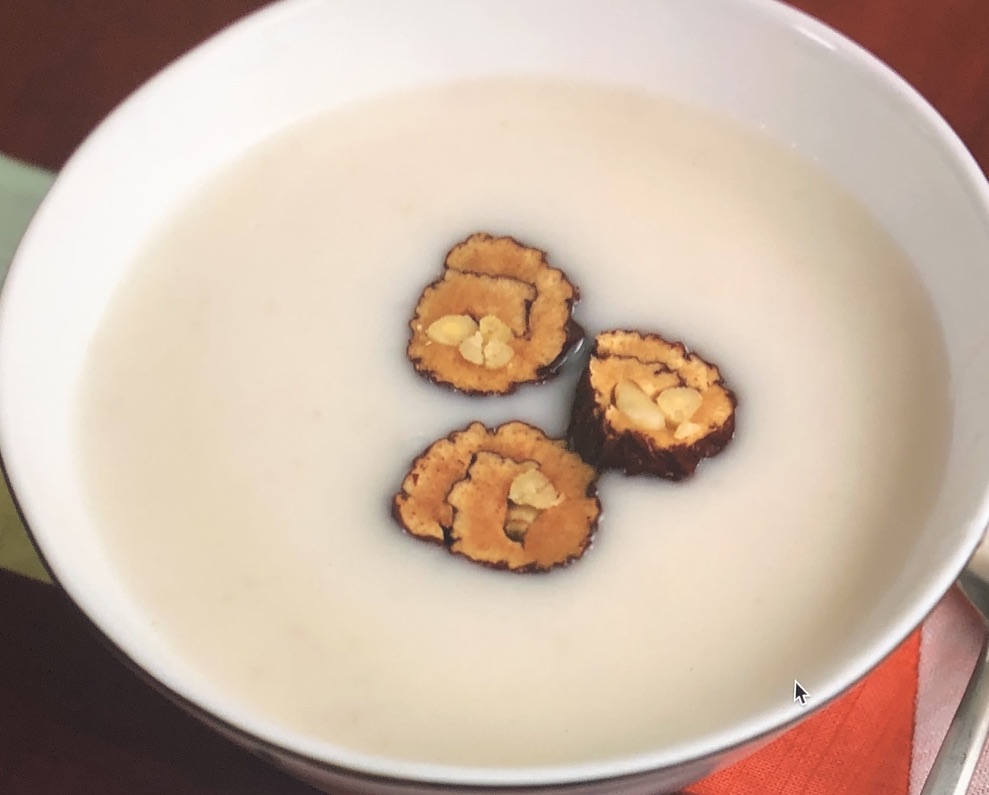
This is considered a Korean medicinal dish to help you recover from many illnesses. It is also served as an appetizer as well as a breakfast dish. We started it the night before it was served and did not blend it as shown below. Nor did we try to make the flower garnish. There simply is not time for the cook to do all this before breakfast. We just sprinkled the extra pine nuts and chopped jujube dates on top of the serving pot as you can see in the full Oryoki service above. Actually we also served this at the June retreat and the cook did try to make the stuffed dates. He ran out of time and we have this version now as a stable. I like to serve one Korean meal in honor or my Korean Zen Master for whom I cooked and the reason I developed a fondness for Korean food, especially Kim Chi, which we had at every meal.
Ingredients:
1/4 Cup Pine nuts
1/2 Cup Short grain rice
3 cups water
Salt
6 Jujube dates
Directions:
Scrub and rinse rice and soak at least 1 hour in cold water. Drain and put in blender with all but 3 pine nuts and I jujube date per serving and enough water to blend 1/2 minute. Use remaining water to rinse out blender. Start at medium high heat and stir. Stir until it gets thicker. Add salt and stir more to make thiner. Bring to boil, reduce heat and simmer for 15-20 minutes.
OR
Start all ingredients the night before in crockpot and do not use blender, chopping all the dates except those reserved for garnish. Also exclude the pine nuts reserved for garnish.
Non-Oryoki Garnish: Remove seed from jujube. Stuff dates with 3 pine nuts. Cut into three slices. Use to make flower garnish as shown floating on top of the pureed congee above.
MAKES TWO SERVINGS.
Baked Tofu:
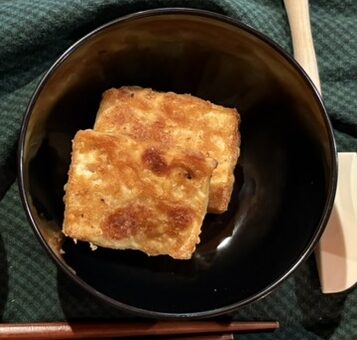
This recipe delivers crispy baked tofu that’s perfect for salads, stir-fries, curries or rice bowls topped with sauce. Both firm and extra-firm tofu work well, though extra-firm has does not need to be pressed. Skip lining the sheet pan here: Direct contact with the metal pan creates more crispiness.
Ingredients:
1 (14- to 16-ounce) package firm or extra-firm tofu, drained
2 tablespoons tamari or reduced-sodium soy sauce
1 tablespoon avocado oil, plus more for baking sheet
½ teaspoon garlic powder, if allowed
½ teaspoon onion powder, if allowed
2 tablespoons cornstarch
Directions:
Arrange a rack in the middle of the oven and heat to 400 degrees.
Remove excess moisture from your tofu by placing it between two clean kitchen towels or paper towels on top of a cooling rack or cutting board in the sink, and then placing another flat heavy thing on top such as another heavy cutting board, a cast-iron skillet, or both. You do not need to do this for thawed, previously frozen, or extra-firm tofu. Allow the tofu to drain for at least 10 minutes.
In a medium bowl, combine the tamari, oil, and garlic and onion powders (if using), and whisk to combine. Cut your pressed tofu into equal-sized pieces ( ¾- to 1-inch cubes). Place the tofu into the bowl with the tamari mixture and toss, making sure the tofu is evenly coated. Sprinkle the cornstarch over and toss until the cornstarch is no longer powdery and has adhered to the tofu.
Lightly oil a metal baking sheet and arrange tofu pieces in one layer. Bake for 25 to 30 minutes (Convection 20-25 minutes), using a thin metal spatula to flip halfway through, until browned and crispy on the edges. Allow to cool for about 3 minutes before biting into them, as they will be very hot. Use immediately or cool completely and store in an airtight container in the fridge for up to 5 days.
SERVING: Serve plain as is or top with kimchi, gochujang sauce (Korean Chili Sauce), and scallions or with dumplings and greens, or with just about anything and sauces.
MAKES 2-4 SERVINGS.
Kimchi:
Ingredients:
Napa Cabbage
1 large napa cabbage (2 1/2 to 3 pounds), quartered lengthwise
1/3 cup coarse kosher salt or 2/3 cup kosher salt, such as Diamond Crystal
Sauce
2 medium red apples (such as Fuji, Gala or Honeycrisp)
1 small yellow onion, peeled and chopped, if allowed
10 garlic cloves, peeled, if allowed
1 (2-inch) piece fresh ginger, peeled more if not using onion and garlic
1/2 cup fish sauce (dulse, soy, miso, mushroom powder, water)
1/3-1/2 cup gochugaru
1 tablespoon granulated sugar or maple syrup
1 bunch scallions, chopped into 1/2-inch pieces, if allowed
Directions:
Napa Cabbage: Dry-brine the cabbage: Rinse the cabbage quarters under cold running water and place on a large rimmed sheet pan. Generously salt the cabbage all over, making sure to season between the leaves as well as the outsides. (Don’t worry about being too precise; since the cabbages leak water, the salt will distribute evenly into the brine.) Set aside to brine at room temperature, cut sides up, until the hard leaves become limp and soggy, about 4 hours, flipping once or twice halfway through. During this brining time, the cabbage quarters should release plenty of water into the sheet pan.
Sauce: Make the sauce: Quarter one of the apples, leaving it unpeeled. Core it, coarsely chop it, then add it to a food processor. Add the onion and garlic, if using, ,and ginger, and process until finely chopped. Add the mixture to a large bowl and stir in the fish sauce, gochugaru and sugar or maple syrup. Peel the remaining apple, quarter it, core it, then thinly slice it crosswise. Fold the chopped scallions, if using, and thinly sliced apple into the sauce.
Rinse the salted cabbage quarters under cold running water, squeezing them of their excess liquid. Place one cabbage quarter into the bowl with the sauce. With clean hands, smear 1/4 of the sauce all over the outsides and between each leaf, tucking in the larger pieces of scallions and apple as well. Fold the cabbage quarter in half crosswise, gathering the leafy tail ends together and bringing them up and over the root end, to create a compact bundle. Place the bundle in the jar and repeat with the remaining three cabbage quarters until you have used up most of the sauce and the jar is filled with sauced cabbage, leaving about an inch of room on top. (A few air gaps are fine; they’ll fill with liquid over time.) Top the jar with any remaining sauce left behind in the bowl. Loosely close with a lid (see Tip). You can wash your hands at this stage.
Carrots and Radish: You may also add carrots and Korean radish or Japanese daikon at this time sprinkling around cabbage quarters.
Fermentation: Let the jar of kimchi begin fermenting on the kitchen counter at room temperature for 2 to 3 days. After this, the cabbage should have released even more of its liquid; it’s OK if the liquid doesn’t completely cover the cabbage at this point, though it may. (This is a very juicy recipe.) Refrigerate the kimchi to finish fermenting until it’s sour, 2 to 3 weeks and up to 6 months, at which point it will be very, very sour and should be eaten or turned into jjigae. Check (and taste!) the kimchi every 2 to 3 days both to familiarize yourself with the fermentation process but also to allow gas to escape, which you can do by opening the lid every so often. As you go through the jar over time, take out one cabbage quarter at a time and chop it into bite-size pieces to serve. You can eat the core or toss it.
CLICK for October 21, 2026 article on “An Oryoki Lunch-Native American Theme” with recipes and links to more articles on Oryoki.








Add comment